

- Humanities AP Modern European History
- Humanities English 10
- Perspectives on the Human Experience II
- Chemistry
- Algebra II
- World Language
- Elective
EXPLORE
The Center for the Humanities is an interdisciplinary, liberal arts program with core courses emphasizing a specialized study of history, literature, art and culture.
In more concrete terms, students in the Center for the Humanities will take advanced and specialized Social Studies, English, and Humanities courses that will foster critical and creative thinking, develop written and oral communication skills, and cultivate imagination and curiosity.
What kind of education will be most useful ten or fifteen years from now, when technologies we haven’t thought of yet are changing our lives? Those who have mastered the skills of listening carefully, asking insightful questions, solving problems, and working collaboratively will be equipped for success no matter where the future takes us. Not only will serious engagement in the Humanities prepare students as they navigate higher education and career pathways, it will also animate and enrich the human experience now and in the future.
Center for the Humanities Monacan High School 11501 Smoketree Drive North Chesterfield, VA 23236 Mark Davis - Program Coordinator 804-378-2480 x246
Our Mission
The Center for the Humanities exists to engage students in a rigorous, interdisciplinary learning environment that supports, develops, and encourages academic, intellectual, social, and emotional flourishing. Through the study of the liberal arts and humanities, students cultivate curiosity, creativity, imagination, and critical thinking so that our individual and collective past and present can shape the direction of our future.
Our History
The Humanities Center was founded in 2000. Our first class graduated in 2004. Since that time, the Center for the Humanities has produced hundreds of graduates who have entered an impressive variety of colleges and universities. These graduates have gone on to assume a diverse array of roles in the real world.
Humanities students are led through a challenging and engaging curriculum by award winning educators with diverse areas of expertise and years of teaching experience. Students share a core of classes with Humanities Faculty and their fellow Humanities students, but also take numerous classes outside the Center, where they become vital contributors to Monacan High School as a whole.
Through the study of the humanities, students are exposed to ideas and experiences in history, science, literature, philosophy, and the arts. As students read, write, and engage in discussion, they think critically, learn to express themselves clearly, and adapt to changing circumstances.
What kind of education will be most useful ten or fifteen years from now, when technologies we haven’t thought of yet are changing our lives? Those who have mastered the skills of listening carefully, asking insightful questions, and solving problems will be equipped for success no matter where the future takes us. These are the kinds of people who graduate from Monacan High School’s Center for the Humanities.
Our students are curious about the world — where we have been and where we are going. They ask questions. They are interested in history, literature, languages, architecture, politics, science, philosophy, and the arts — and the cultural contexts from which they emerge. Our students read books (and blogs), watch films (and movies), and listen to symphonies (and songs). They have a voice — on the page and in conversation and debate. They have healthy and active imaginations. They learn through reading, listening, making, moving, and doing. They embrace the complexity and nuance found in the world and in each other. Our students are athletes, artists, performers, and volunteers – each remarkable and containing multitudes.
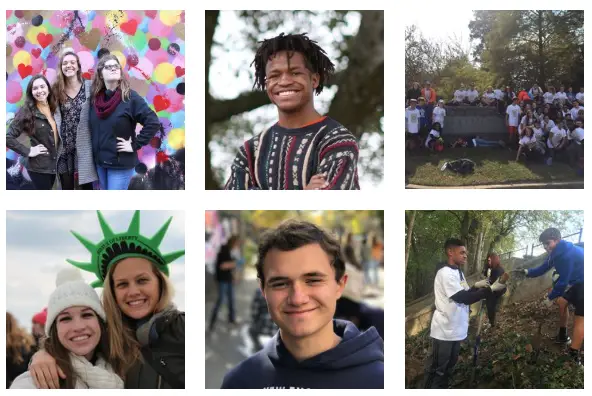

For some, studying the humanities is a life-long passion that inspires and directs educational and vocational interests. Many of these students continue to explore history, writing, and the visual arts. For others, studying the humanities and liberal arts builds a strong foundation of critical and creative thinking propelling learners towards STEM, Business, Finance, and more. Students arrive from different places with different perspectives, each with different destinations in mind. Each student discovers his or her own path and direction, not alone, but together, with support from teachers, families, and classmates.
As Humanities Graduates continue their trajectory of learning and growth, and further their formal education, in the arts and the sciences, we find them studying at variety of colleges and universities, both near and far. Our graduates study a wide range of disciplines, and they find our rigorous curriculum and our emphasis of service and citizenship has amply prepared them for their university studies – and the world beyond.
Our Graduates are Writers, Doctors, Artists, Scientists, Musicians, Engineers, Designers, Teachers, Programmers, Consultants, Curators, Lawyers, Lobbyists, Accountants, Physical Therapists, Editors, Psychologists, Managers, Ministers, Administrators, Officers, Researchers, Fiduciaries, Journalists, Etc.
“What I like best about Humanities are the open minds, thoughtful conversations, and variety of viewpoints that our curriculum encourages.” - Member of the Class of 2008
“I have two favorite things about the Humanities: The curriculum and the family feel. I plan on attending a liberal arts college and the intense, but manageable Humanities Center curriculum will help me there. The experiences of working in groups and in Socratic seminars have been wonderful preparations. The other great thing about Humanities is how close we all get - the faculty and the students. I truly feel I have a strong family behind me.” - Member of the Class of 2011
"I like the integration of the core classes within the program. When you learn about something in World History class, you may write about it in World Literature class. It takes your weak points in a subject and allows you to make these weaknesses some of your strong points." - Member of the Class of 2011
We are a four year program in the liberal arts with our core courses including and emphasizing a specialized study of history and literature, art, and culture. “The humanities” also refers to the interconnectivity of human endeavors through time and culture. So, we study the development of civilizations and how history influences literature, arts, math, and science. We certainly “lean into” English, history, and the arts; however our students get full and demanding courses in math and science. A study of “the humanities” is a study of culture (history, literature, music, philosophy, painting, sculpture, architecture, archeology, dance, religion, political science, psychology, anthropology, film, photography, and more).
Too often, a false binary pitting the arts and sciences against one another inhibits our intellectual and social development. A full study of the humanities rejects this bifurcation, and instead, promotes both liberal arts and STEM opportunities, realizing that they are deeply connected. Music and math are more like cousins than strangers. The study of history and geography requires an understanding of environment and ecosystem; raw materials and natural resources, explored and imagined through scientific inquiry, inspire innovators and technologists. World history, culture, current events, and global markets are entangled. A study of the liberal arts and humanities enrich and fulfill our lives in an unparalleled way. The leaders and visionaries of today and tomorrow will benefit enormously from a serious foundation and prioritization of the liberal arts and humanities.
Perspectives on the Human Experience is the third of the three core Humanities courses. Perspectives often “tells the rest of the story,” developing topics and themes of English and history as they relate to art, literature, philosophy, and music. Perspectives differs each year since it integrates with each grade level of Humanities English and history. So, for example, in 9th grade, students may study ancient Greek architecture, art, and philosophy when they study Ancient Greece in Humanities world history and English. They might also make a Greek vase or create their own Greek Classical sculpture. But, in 11th grade, Humanities students will study American history. So, in Perspectives, they might read The Crucible, learn about colonial art, and listen to early American music since these integrate and relate to their studies of colonial American history.
Students who show an enthusiasm for history, reading, the arts, and express a curiosity about the world around them should apply. Our students are academically well-rounded but have a deep interest in history, reading, art, and culture. Students should have a strong academic record in middle school. It helps greatly if a student has at least one year in a world language and has taken (or is taking) Algebra I.
Chesterfield County currently provides transportation for out of zone students but does not provide door-to-door service.
Because of Humanities core classes and scheduling, students experience up to five classes with students in their cohort immediately. As students become familiar with one another, they start building community at the onset of the program. In addition, students are taught by a faculty that is able to team teach, plan together, and build integrated curriculum. In some schools, students may study American history at the same time they are learning about British literature. In the Humanities Center, we provide a curriculum where instruction of literature and history align, integrate, and connect in a way that may not be possible in other schools.
Like other centers, Students will be incredibly well prepared for college in a variety of ways. Here, our graduates find that they have the content and academic background to succeed as well as possess skills for seminar discussions, group work, and presentations.
The Humanities Center provides students with a smaller family setting within a larger comprehensive high school. Students will have a different approach to academic subjects, working with a team of teachers for each grade level. Students will have college level textbooks, a different English curriculum, student-led discussions (Socratic Seminars), creative group projects, and academic and service field trips. Students will create documentaries using video-editing software and digital camcorders as well as canoe the James River or test water and air samples on the Chesapeake Bay! Students will have a deep, varied, and rich education with unique experiences and opportunities.
Most students will have five freshmen Humanities courses. You will have the three core classes of Humanities English 9, Humanities World History 9, and Perspectives on the Human Experience I. Most students take Humanities Geometry and all take Humanities Biology. All courses are honors level. Students will take a world language and either PE/Health 9 or an elective such as art or band. If a student wants to take an elective instead of PE/Health 9, then he/she will take PE/Health during the summer or through the CCPS Online course offering (either during the summer or during the school year independently).
Yes! Humanities students are meaningfully involved in sports, theater, band, and many clubs. Many hold class office or are officers in clubs such as Latin Club, National Honor Society, Beta Club, and the Student Government Association. Visit the athletics and club pages on our school website for more details.
It will vary. Generally, students can expect anywhere between 1-3 hours of homework nightly. At times, such as with projects or exams, students may spend more. Other times will require less. Most students say the workload varies and can increase in higher grade levels. Students find the workload rigorous, but manageable.
The beauty of the Humanities program is that it creates opportunities for further study; it does not limit a student’s choices. Our students have gone on to study medicine, business, engineering, as well as the arts, English, history, education, pre-law, and political science.
A Rigorous Academic Program with a Heart
Welcome to the core of the Humanities Center – its academic program. This program is a challenging and rich academic experience that also weaves a sense of family among its participants.
The curriculum at the Humanities Center engages students in study that is both broad and deep. It immerses students in core humanities courses that connect the threads of social studies, literature and culture both chronologically and geographically. The result is a picture of the human experience that makes sense. In addition to the core Humanities courses, students will explore a broad range of challenging science, math and elective courses.
Because students have different entry points into World Language curriculum (some begin in Middle School), students are encouraged to consider taking five years of world language. Our minimum requirement is that students take four years of world language (including at least two years in high school). Two years of required physical education and health may be taken in place of an elective, as an after school class or a summer class. While specific upper level math and science courses are not administered through the Humanities curriculum, Humanities students are required to take math and science courses in each year of high school.
All Humanities core courses are honors level, or AP, and will lead to an Advanced Studies Diploma with a special Humanities seal. Colleges look favorably on students who participate in an academically rigorous program.
Service Learning is part of the Humanities Center Curriculum. The course requires students to perform community service throughout their four years in the Center for the Humanities. This allows them to receive a credit in Service Learning at the end of their senior year. During this time, students will be exposed to contemporary social needs facing our society, and they will learn the role volunteers play in finding possible solutions. Each year, students focus their energy and effort on a service theme (Environment, Shelter, Literacy). During their Senior year, students work together to plan a unique service project. 9th Grade – Environment, 10th Grade – Shelter, 11th Grade – Literacy.
**Students are required to complete 2 years of Health/PE and 1 year of Personal Finance/Economics. Students who wish to optimize their schedule for elective opportunities should consider completing those requirements through online and/or summer coursework.
While reading, writing, observing, listening and talking can all be part of any learning experience, it is the doing that really makes what we learn stick.
For students at the Center for the Humanities, projects are one important way that lessons are made to come to life. Throughout all four years of the program, students are asked to come together in small groups to explore some of the broader ideas brought to light in their classes.
In most of these projects, students are asked to fuse knowledge examined in their history, literature and Perspectives classes into a single, cohesive whole. The opportunities available for creativity, cooperation and even humor easily make these learning experiences some of the most meaningful and memorable for Humanities students.
Storytelling, skits, musical performances, documentary film, painting, sculpting, and photography are just a few of the ways students learn to express their learning. Here are examples of capstone documentary film projects
The Center for the Humanities encourages students to travel and to learn first hand about the history, artwork, and cultures they have studied. One way that we help to support student learning is through sponsoring field trips. In the past, Humanities students have traveled to the cities of Boston, Charleston, Philadelphia, Washington, D.C., as well as to Lancaster and Gettysburg, Pennsylvania. Seniors travel to New York City on a nearly annual basis. Students also have traveled abroad to China and Costa Rica. Humanities Freshmen travel annually to the Chesapeake Bay. Humanities students are fortunate to have the support of Human Ties, our parent booster organization, which helps support these “outside the classroom” learning opportunities.

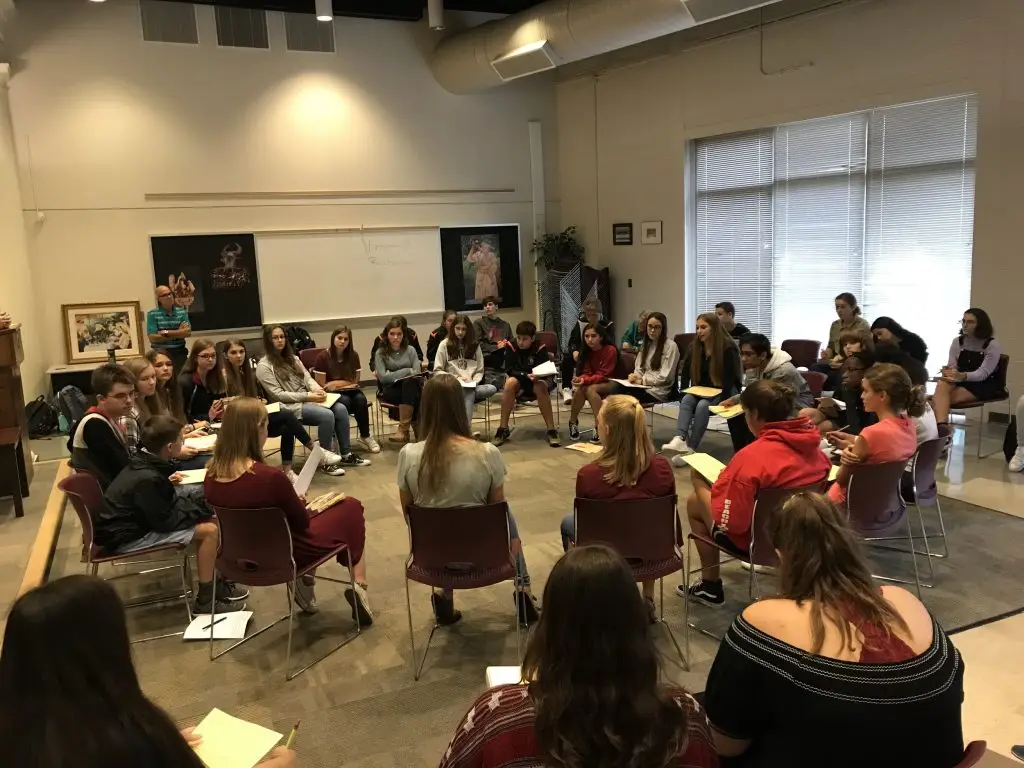
What is a Socratic Seminar?
Socratic seminars are student centered discussions in which a broad, often timeless, question is addressed and deliberated.
Six to ten students generally sit in a circle and converse about questions that are relevant to what is being studied. Skills of intelligent, interrogative analysis are nurtured and practiced as students thoughtfully create answers to difficult questions informed by various historical and literary readings.
Most often this technique is used in the Humanities Center core classes (English, Social Studies and Perspectives), though it is also incorporated into non-core Humanities Center classes, such as biology, to discuss issues of ethical concern.